Thursday, October 30, 2014

Treasure Chest Thursday: The 4-Eyed Man, or Even Ugly Objects Have a Story.

"Cause someday, believe it or not, you'll go 15 rounds over who's gonna get this coffee table. This stupid wagon wheel ROY ROGERS GARAGE SALE COFFEE TABLE!"
- When Harry Met Sally 

"With as much dignity as he could muster the Old Man gathered in the sad remains of his shattered major award.  Later that night, alone in the backyard, he buried it next to the garage.  Now I could never be sure, but I thought that I heard the sound of "Taps" being played, gently."
- A Christmas Story


This little bank has been my wagon wheel coffee table, my leg lamp, my I'm-so-not-saving-this-thing-in-the-fire object. He has this face on one side, and a normal face on the other.  And in our new house, to my husband's great joy, he has been 'rediscovered' and given pride of place in the living room.  TraLa.

My understanding was that it was some sort of heirloom from my husband's family.  But no, his aunt who is their heritage keeper has no recollection of it.  She figures it came from her grandmother's antique shop.  This alone did not endear me.

I did a little research and discovered that the face is pretty common, though it's usually on bottle openers, not banks.  It is a folk art reference to over-drinking and was apparently common in the 1940s.  So that's sort of interesting.

My husband asked his mom about it, since his dad died many years ago.  She said they'd put it out at cocktail parties with the normal face facing outward, and somewhere during the night they'd turn it around and see who noticed.  Now that's a story I can get behind.

Once an object has a story, it becomes so much more meaningful.  I'm not sure it's meaningful enough to stay in the living room, but it helps.  And I don't mind having a little reminder of the great parties for which his parents were renowned.  So now I'm glad I didn't follow my leg lamp instincts and subject it to a tragic dusting accident.  And I'm interested to see what happens at our next party . . .

For $98, you can have your own version from Dolly Python Vintage!


Wednesday, January 8, 2014

Thriller Thursday: The Murder and (Repeated) Burial of William James Jones

The Jones family is replete with expert BSers, who sometimes go too far.  There is even a family phrase for it, based on an incident where my grandfather tried to convince his sons that the Douglas Fir was named for a long-lost Governor of Oregon.  "Governor Douglas" means that you've spun the tale out too far, that you've created a story or faked a fact so utterly absurd that you've lost credibility.

So when I heard that there was a great-great grandfather out there who'd been murdered, you'll forgive me for taking it with a tablespoon of salt.  But it turns out that not only is the murder story based in fact, but it sounds like the family BS talent may have done him in . . . .

Based on newspaper clippings that kind people have linked on Ancestry.com, the story seems to be as follows:
  •  William James Jones was born in 1811 in Kentucky, married in Indiana, and in about 1848 had made his way along the Oregon Trail, with his children and several related families to Yamhill County, Oregon, where they founded the town of Newberg.  
  • By the 1890s, everyone in town knew he had a lot of money.  According to the local paper, everyone knew this because he had told everyone this.  The generally accepted figure was $17,000 - or about $450,000 in today's dollars.  But in terms of relative wealth, it was 3.5 million dollars (according to this useful calculator).
  • In 1891, at the age of 80, William went to live with his daughter Irene and her husband, David Everest.  About $7000 of the $17,000 was in the bank, but the rest, according to William, came with him in a locked trunk. 
  • On Feb 15, 1892, Irene made him a special meal of his favorite food.  Right after the meal, he stumbled out to the outhouse, complaining of stomach pain, and died.   
  • Irene's sister Rosanna and her husband, the McGuires, lived nearby but seemed to be feuding with the Everests.  So Rosanna only heard of the death of her father when her son went to town, and then drove quickly to the Everest house.  Rosanna claimed that his mouth was foaming, and that his stomach was so bloated they had to use an unusually large casket.  
  • The McGuires decided that the Everests had poisoned William, to get his money.  And they tried to hire a Pinkerton detective to figure it out, but couldn't afford the $250 it would take.  They apparently asked the Everests to chip in for the detective, but they weren't interested.
  • There apparently wasn't any money in the trunk.  This is not a surprise to anyone familiar with the Jones BS skills, but was apparently very surprising to Irene and Rosanna.  William's four other children, you'll note, seem to be staying well away from this drama.
  • William was buried in Dundee Cemetery, but in 1893, his body was found on top of his coffin.  Some said it had been disturbed by rooting pigs, but most seemed to suspect either the Everests or the McGuires.
  • In early 1894, the Everests spent $1000 (!!!) to hire a detective to prove that the McGuires had injected poison into the body after William had died, when they had dug up the body in 1893.  The detective could only find evidence that pointed to the Everests, who then refused to pay him.
  • In September 1894, the McGuires convinced the county to get the body disinterred officially, so that the contents of his stomach could be examined.  They did this, and the examiner concluded that there was poison in his stomach, but charges were never brought.  
Now, I suspect that there was Governor Douglasing going on in this family a long time before my grandfather coined the term.  I suspect that Rosanna and Irene couldn't tell when they were being Governor Douglased, and didn't have a sense of humor about it when it happened.  All Jones kids have this phase at about age 13, but Irene and Rosanna don't seem to have grown out of it.

I also suspect, based on decades of experience and on the fact that each of my relatives has been, with great public outcry, written into and out of my grandmother's will many times, that William discovered that his life was a little better as an old man with $17000 than it was as an old man with $7000.

At least for a while . . .

So I'm off to watch Alfred Hitchcock's The Trouble with Harry in memory of William, my poor murdered, buried, unburied, buried again, unburied again, and finally buried great great grandfather.

May your wealth be high enough to make you happy, but not so high that it becomes dangerous to health or final resting place . . .


Saturday, December 28, 2013

New Year's Day Special: Phraseological Genealogy of "Until The Last Dog Is Hung"

"We'll keep going until the last dog is hung"

It's funny how the phrases that your mother uses are so woven into to your worldview that their strangeness never occurs to you.  Years later, you use them and your spouse gives you a quizzical look and you realize that your ordinary phrase is someone else's complete non-sequitur.

So that phrase - "We'll keep at it until the last dog is hung" has always been part of my world.  When my mother is at her most tired, and her most determined, out it comes.  We always knew exactly what it meant.  Sure "Come Hell or High Water" could be used.  There are probably dozens of phrases women have used to describe that moment of exhaustion and determination.  But this one is my mother's.

Then I read this in a novel:
"Even now things that people thought of as regional attitudes and expressions come straight from the Senecas. When anybody from around here wanted to say they were still present at the end of a big party, they would say they had 'stayed until the last dog was hung.' Most of them probably had no idea anymore that they were talking about the Seneca New Year's celebration in the winter, where on the fifth day they used to strangle a white dog and hang it on a pole, Nobody had done that for at least a hundred years." Dance for the Dead by Thomas Perry (Random House, New York, 1996)
I don't know whether this is true or not - if so, I'm glad the actual ritual had disappeared.  But its metaphoric remnants intrigued me.  My mother was born and raised in Oregon, and raised me in Colorado.  Her parents were both born in Oregon.  Her grandparents were born on the West Coast as well.


How could a phrase from a tribal ritual in upstate New York have ended up completely integrated into my mother's vernacular?  I asked her where she learned it, and she doesn't remember her vocabulary without it.  For her it isn't specific to staying until the end of a celebration or a party, but rather sticking to any situation until it is completed.

So into the family tree I went.  And sure enough, four generations back from mother, there he is.  A great grandfather born in 1820 in Schroon Lake, Essex County, New York, deep in the Adirondacks.  Here is a Thomas Cole painting of the lake from about 1840.  And his father was born in Floyd, Oneida County, New York in 1783.  Floyd wasn't officially founded until 1790, and Schroon in 1804.  This was a frontier family, living in Mohawk and Oneida territory.  Maybe the ritual was more widespread than the Seneca alone..

So there we have it - maybe, somehow, (and remember, this is Genealogy Imaginings not Genealogy Certainties) this phrase was passed down and persisted all the way to the other side of the continent.  Maybe the meaning changed a little to reflect the things that made these new generations tired, or maybe the original party sense didn't translate well in the first place.  But it was a useful phrase, and it lasted, and I enjoy the idea.

Happy New Year.  May you party just long enough, avoid harming any pets in the process, and have a great 2014.


Monday, October 21, 2013

Madness Monday: Halloween Special: Mary Allin Toothaker

My 11th great-grandfather was a doctor named Roger Toothaker.  The story of his life and the life of his poor wife sends shivers up my spine even when it's not Halloween, but it seems appropriate to visit their story and the madness of the Salem Witch Trials at this time of year . . .

Roger gets his own Wikipedia entry, but his basic story is this:  he was a doctor in Salem, Massachusetts beginning in about 1658.  He and his wife Mary had nine children, including my ancestor Andrew.

Now, medicine was a pretty ethereal game in those days, and people that couldn't be cured by the rudimentary options available were often assumed to be cursed.  Perhaps to keep his reputation, Roger at some point claimed that his daughter Martha had killed a witch.  This was probably risky - it explained one death, but might have lead to a lot of resentment from other people he hadn't treated successfully - if he had this witch-killing power in the family, why wasn't it used to kill witches afflicting other people's families?  To make this all a little more complicated, one of Dr. Toothaker's main rivals, Dr. Griggs of Andover, had made several witchcraft allegations.  It was only a matter of time, perhaps, before Dr. Toothaker himself was accused - by several people, including Dr. Griggs' servant.

Shortly after Dr. Toothaker was taken to prison, his wife Mary, daughter Margaret, sister-in-law Martha Carrier and cousin Elizabeth Howe were also accused and put in jail.  Mary was jailed with her youngest daughter Margaret, who was 10 at the time.  Martha Carrier was jailed with 4 of her 5 children.  Apparently, she had a husband who wasn't capable of making deals and trades himself with the neighbors, so Martha had to negotiate with the men around her, which was not appreciated by her neighbors.  When accusers against Martha came forth, Mary and Roger's son Allin was among them.  Elizabeth Howe had six children and a blind husband, and was accused along with Rebecca Nurse by the group of girls at the center of the trials.

In late June of 1692, less than a month after his arrest, Dr. Toothaker died in prison.  Though it was well known that accused witches were often tortured in prison, 24 men were brought forth to testify that he died of 'natural causes.'  (This seems to me like it may be a case of protesting a bit too much . . .)

On July 28th, Elizabeth Howe, Rebecca Nurse, Sarah Good, Sarah Wildes, and Susanna Martin were hung as witches.

On July 30, when she must have been mourning the deaths of both her cousin and her husband, Mary confessed to striking a deal with the Devil in order to protect herself from the Indians, who had attacked the colony frequently and of whom she was terrified:

And he promised if she would serve him she should be safe from the Indians (she was then a litle stopt again & believed it was the Devil that did it)// Being asked if the Devil did not say she was to serve him Answered Yes, and signed the mark upon that condition and was to praise him w'h her whole heart, and twas to that appearance she prayed at all tymes for he said he was able to delyver her from the Indians And it was the feare of the Indians that put her upon it. 
On August 1, the empty Toothaker house in Billerica was burned to the ground by angry neighbors.

On August 5, Martha Carrier and 4 men were hung.  One of the others was John Proctor, whose story is the core of The Crucible by Arthur Miller.

 Despite her confession, Mary and Margaret were not released until January 1693, long after the main furor of the trials had died down.

After her release, Mary bravely continued to work helping the sick.  All the surviving accused people were pardoned in 1693.  Elizabeth and Martha's survivors received a few pounds of compensation in 1709.

If this were the end of the story, it would be horrific enough.  But in 1695, the Indians Mary feared so much attacked Billerica again.  Mary was killed, and her daughter Margaret, who had endured so much in prison with her mother, was captured and never seen again.  Mary's nightmare, the one that seemed so much worse than selling her soul to the Devil, had come true.

Friday, August 2, 2013

Friday Funny: Wait, I'm What? Or How Ancestry DNA Has Messed With My Reality

I think I should probably start you where I started, with my own name:
First Name: Rhiannon
Middle Name: Kathleen

Recent Family Surnames: Jones, Evans, Potter, Mauracher, Branson, Kern, Lorentzen, Tuggy, Parrish, Lasswell, Hawes, Sheldon, Tharp.  For those of you keeping track, that's Welsh, Welsh, English, Austrian, English, Irish, German, English, English, Irish, English, English, and English.  Forgive me for thinking there must be some British DNA coursing through my veins.

When I got my Ancestry DNA results, though, they looked like this:


Wait, what?

Attached was a lovely letter telling me all about my Italian and Swedish ancestry.  I have two great-grandparents who came from Austria, and one from Denmark.  Otherwise, everyone is pretty darn British Isles, way way back.  25% Austrian, 12.5% Danish, and 100% pretty confused, that's me.

My son is thrilled, he now tells everyone we are Italian.  Apparently it is considerably more hip than Irish in elementary school.  And he's a huge Cake Boss fan, which may be a coolness factor.  He's sure we're related to Buddy now.

Conveniently, I got the letter the same day I went to my dad's family reunion.  Though there were a lot of raised eyebrows, I assure you that they were very similar eyebrows in faces that looked, for better or worse, so much like mine that I'm pretty sure they are my genetic relatives.

I figure the Southern European piece comes from the Austrian Tyrollean folks, which is actually quite close to the Italian border.  So I'm willing to give them the 18%.

But I am a little appalled that after years of trotting out my Welshness at every opportunity, right down to attending Celtic Festivals with a pout due to 'our' under-representation, I don't have the genes to back it up.  I have a Welsh flag.  I have all these little blippy bits on the map above, which represent birthplaces on my family tree.  I married an Irishman, I have red hair and a red-headed, Irish monikered son.  I have known the story of my legendary namesake Rhiannon (no, not the Fleetwood Mac song) since preschool.  I know who I am, darn it.

Or not.

I get the Scandinavian conquerer aspect, I do.  I know that the red hair is a Scandinavian thing, I know they've been trotting/breeding around the British Isles for millennia.  But still, I'd expected a little something Celtic.  Or Anglo-Saxon.   Or Gaelic.   A bit of inter-marriage to back up all those surnames doesn't seem a lot to ask.  So I'll see if the data changes as more people try the Ancestry DNA approach, but try to embrace my new self in the meantime.

So I'm trying to use my hands more when I talk, and considering changing my name to Regina, which means the same thing as Rhiannon.  And there must be a Scandinavian Festival around here somewhere, where I can pout because the Danes are neglected . . . .

Thursday, July 25, 2013

Those Places Thursday: Why Smithfield Market is Important in Our Locavore World


In 1993-1994, I was at University College London on a Fulbright Scholarship for the study of Victorian Geography.  After a key hotel in my first topic, Scarborough in Yorkshire, fell into the sea, I decided to come up with a second and more convenient topic.  I chose the Smithfield Market.

Today, the City of London and various historic organizations are struggling to determine a plan for the market building.  This is a question that, I think, is more broad than the structure itself.  Which is saying something - it is a LARGE building.

For my research, I was fascinated by how the urban depictions of the market and its participants evolved as London developed into an industrial city.  A market which started out in the 14th century as a natural part of the city became, by the end of the 19th, an object of ridicule and derision.  The farmers who came to the market, and their animals, were seen as fat, uncouth bumpkins who were dazzled and amazed by sophisticated urban London, even as the Londoners happily ate the products provided.

It was a microcosm of the industrial and post-industrial detachment from food sources, from farming, and from rural people.  But we are now learning, across the globe, the consequences of that detachment:  GMOs, pesticide-contaminated food supplies, wide disparities of food quality, and disregard for food production, from farmers to honeybees.

Smithfield is a symbol of the long-gone balance between urban and rural, the ways in which the two populations need each other and need to support each other.  We have lost that relationship, pushed the farmers farther and farther away even as our city edges expand, and we no longer recognize their importance.

In Denver, we have the National Western Stockshow, which comes to the city every January.   Hundreds of thousands of people go to the show, wearing their best cowboy gear.  The cattle are paraded through the downtown.  The Junior Livestock Auction is broadcast on TV.  For a week, we connect with the farmers and ranchers upon whom we depend.

Around the world, we are attempting to reconnect: the locavore movement, the slow food movement, the farm-to-table movement - these are all connection opportunities.  I think it's only fitting that while we are making these changes, we are also preserving the old connection points, like Smithfield.  There are always things to be learned by understanding our past, particularly in this fragile moment when we are just starting to recognize what we lost in between.

Wednesday, July 17, 2013

Wisdom Wednesday: What We Bring to Our National and Personal Stories

This week, stories on the Internet whirl around powerful issues - stereotypes, profiles, justice.  These are good conversations to have out loud, instead of in our respective minds and insular communities.  Because when we move these conversations into the open, we can examine the assumptions, expectations, fears and aspirations behind them, and that, I think, is good for both personal and global storytelling.

In a modern world where all of us can become storytellers to strangers, many of the filters set in place to moderate stories told by journalists and authors no longer limit stories we tell or read - lines between truth and libel, fiction and reality are increasingly blurred.  And with that lack of official filtration comes an ethical need to recognize and acknowledge what we are bringing to the tale - our assumptions, expectations, fears and aspirations.

One of my storyfathers is Dr. James Coleman, who wrote the book Black Male Fiction and the Legacy of Caliban.  I studied African-American literature with him, more than a decade before he wrote the book.  He was frustrated, when I was in class, by the national fascination with Alice Walker's The Color Purple. He felt that the book was popular among white readers because it fulfilled expectations about violent and animalistic black men.  He felt that these depictions of black men made white America feel better about years of oppression.  In the Caliban book, he argues that many male writers also fulfill those expectations, in part because the narrative is so strongly represented, and alternative stories are so rare.

Looking at The Color Purple through his eyes changed the way I read the story.  I didn't forgive the men in it, but I viewed them with  a different understanding.  I had to consciously choose to read them as complicated characters, who had their own untold stories of oppression, anger, and struggle, rather than as simple stereotypes.  This complexity came back to me a couple of years later when my fellow college students were harassed by police after the Rodney King riots.  The police took the LA riot narrative and made assumptions about young black men attending a little liberal arts college in Minnesota.

In our attempts to simplify the complexity of our world and the myriad people in it, it seems to me that in all the stories we tell - whether national news or personal narrative, we are doing a combination of these things:

1.  We are making assumptions about the story.  We are bringing our personal and cultural history into our hearing, our telling, our editing.

2.  We are bringing our expectations to the story.  We have an idea of how the world works, and we seek out the pieces of the story that fit those expectations.

3.  We are bringing our fears and aspirations to the story.  We have fears about the world and how it works, and we have hopes for how the world should be, and we seek out the pieces of the story that fit those visions.

In personal storytelling, this plays out in many ways.  The beloved grandfather couldn't possibly have committed adultery, so it isn't talked about out loud.  The angry uncle who never comes to Christmas couldn't possibly be his town's biggest philanthropist, so his family doesn't realize it until the story emerges at his funeral.  The war-hero cousin couldn't have PTSD, so she struggles alone, without family support, afraid to damage the stories her family tells.  Into our personal stories, we carry our aspirations for our loved ones; our expectations for their stories; our assumptions based on our own interactions with them; our fears of who they might be and what it would mean to who we think we are.

We do the same in our national and global narratives.  Right now, the nation focuses its attention on a single story and all of these assumptions, expectations, fears, and aspirations come into the dialogue.  Mr. Zimmerman brought his expectations of Mr. Martin into his decision-making, and ended Mr. Martin's life.  Many people rationalize his actions using the national narrative about young black men.  And in his acquittal, many other people see their expectations of a biased justice system fulfilled.
Fundamentally, the jury selection process is supposed to be an act of separating people from their stories - finding the people who can look at the stories told by defense and prosecution, and bring nothing of their own to those stories.  As a citizen, I hope it's possible.  But as a storyteller, knowing how deep these stories run in our history and in our souls, I worry.

Tuesday, July 16, 2013

Tuesday's Tip: Using Protopage to Organize RSS Feeds and Replace What Google Took Away

I didn't use Google Reader much, but its discontinuation has clearly thrown a lot of people off.  I did use Google home page, but that was discontinued several months ago.  So for those of us who loved those tools, my Tuesday Tip is to use my new favorite: Protopage.com.

5 Things I Love About Protopage:

1.  It allows for customizable tabs, so I can easily organize my feeds by topic.  All my genealogy feeds are on one tab, all my art feeds are on another, all my cooking ones are on another, etc.

2.  It keeps track of which articles I've read by crossing them off on the page, so it's easy to scan for new entries.

3.  It allows for non-RSS widgets as well - comic strips, games, and even To-Do lists with checkboxes, which I find very handy.  I have multiple to-do lists for home, work, etc.

4.  It is easy to set up and customize with colors, etc. and offers customization at the feed level - how many headlines appear, whether there are pictures, etc.

5.  I can choose to make my page with the feeds I like public or private.  Because of the to-do lists I choose private, but there may be value for many people in using pubic instead.

So give it a try.  I think you'll find it's a great replacement for what you think you're missing now that Google has moved on.

Wednesday, July 10, 2013

Wisdom Wednesday: Mrs. Petra Fogelberg and Her Love Lessons

When I was studying at Macalester College, I spent a few months earning extra money as an assistant for an old woman who had lost her sight.  She had gone to Macalester as well, and so advertised at the school for help.  She died about five years later.

She had been married for decades, but had no children.  I can't find her in online records.  I don't know if she had family members who remember her.   Though I spent several hours with her for months, I am sure there is a lot that I don't remember.  For me she is a tall, white-haired story collection.  And in a way, twenty years on, maybe that's not a bad thing to be.

Here are some of the stories I remember her telling:

  • She remembered going to college in World War I, and watching all the men disappear from campus and go off to war, leaving the college barely able to sustain itself. 
  • Even though she went to college herself, she didn't work outside the home, but seemed to thrive on being a doctor's wife in small town Minnesota, getting paid in chickens, getting up in the middle of the night to attend to expectant mothers.
  • In the little retirement apartment she lived in since her husband died, she had a whole closet full of what she called her 'mad hats'  Whenever she and her husband fought, she went out and bought herself a hat, and she kept her favorites despite the downsize in home.  If I described a particular hat, she could remember what it looked like, where she bought it, how much she paid, and what the fight was about.
  • She never forgave the Mayo Clinic for the death of her husband from kidney cancer.  She felt they sent him home knowing how ill he was, wanting him to die off their books.
And the most telling story was this: half of her bed was piled with boxes of papers.  I asked her once if she wanted me to move them, and she said "No, I was married too long.  Now, I can't sleep without weight on the other side of the bed, so I keep all my husband's letters to me on his side of the bed."

Ultimately, many of her stories seemed to come back to her marriage, the strength and complexity of their relationship, the pride in their teamwork, the ferocity of how much she missed him.  I know she told me how they met, but I can't remember it, and that saddens me.  But I knew I wanted a relationship like hers, despite the difficulties she went through.

Not everyone who has a legacy has children.  But they do have powerful, inspiring, riveting relationships, and from those relationships can come great stories.

Tuesday, July 2, 2013

Wisdom Wednesday: The Storyfathers

There are people who are related to you by blood - and those relations are important.  But there are also those people who are related to you by the stories they tell, stories that move you, stick with you, and change you.

My father taught at Colorado College in the chemistry department.  When I was little, there were three other professors who often came to dinner and cherry pie at our house.  None of them teach there anymore.  But the stories they told about their incredibly different childhoods gave me insight and perspective that changed my world.  In my head, they are my storyfathers - my early teachers in the art of agenda-free, moral-free, relaxed, and fun-filled storytelling.

Storyfather One - a white religious studies professor from Georgia.  His stories were full of cottonmouth snakes and Baptists.  I particularly remember a tragic story of his disillusionment when a tent revivalist couldn't help an ill friend.

Storyfather Two - a hispanic Chicano studies professor who grew up in the Rio Grande Valley.  His stories were full of farming and struggle.

Storyfather Three - an African-American literature professor who grew up in the rural South, in a house without electricity or plumbing.  His stories were about being a young man in the middle of a changing culture, and the challenges he faced.

Storyfather Four - my dad, who grew up in Oregon, whose stories were full of my grandmother's antics, car repair, and family.  I remember his story of the whole 1st grade going to his friend Steve's house to see the first TV in town.

Storymother - my mom, who also grew up in Oregon, on a farm with limited resources.  Her stories were full of goats, walnut trees, and architecture.  I remember her story of getting up early in the morning to take Russian lessons through the radio, so they would be ready for the invasion.

While we watched and listened, they would sit and eat pie and talk back and forth for hours.  They could remember the moment they learned to read, the moment they heard about Kennedy's assassination, the moment of the moon landing.  They shared huge events and little ones, and through them, my sister and I came to understand the differences in their histories, the diversity that made up the United States for all of them.

As storytellers, you may not know which of your stories are good and eternal and which are temporary, or only valuable to you.  You may not know their significance, but you owe it to the children around you to give them a chance to find out.  Talk more, talk often, risk being dull or vulnerable or cliched.  You never know which story will expand their world.

Friday, January 25, 2013

Wedding Wednesday: Copper Plate Quest: Whelan & Blair


The latest Copper Plate is from a 1958 Kentucky Wedding.  I have tried to find this family so I can return the plate to them, but haven't been successful yet.  I still have hope!

I found a biography of Gene, from the St. Joseph's Prep School in Bardstown, Kentucky:


.


Born in New Hope, Kentucky on April 17, 1934. Gene was one of eight siblings. His tenure is well remembered for his numerous accomplishments in basketball, football and baseball.

As a freshman, Gene played Junior Varsity basketball and six man football, his talent was evident and he was quickly moved to Varsity during his sophomore year. He continued to hold key positions throughout his junior and senior years as quarterback. , starting guard, and starting pitcher. Baseball was Gene's first love, coached by Brother Carey(1951-1952) and Brother Chad(1953). During his years as pitcher, the Eagles earned State Championship Runner Up on 1951 and  1952, and went on to win the 1953 State Championship his senior year. Gene was selected to the All Tournament Team. St. Joseph advanced to Sectionals and was invited to the South East Regional Tournament where they lost in the first round against Key West, Florida. The Teams overall record was 52 wins and 4 losses during 1951-1953. Brother Charles, St. Joe's headmaster, said that winning the State Championship "climaxed the most successful year the prep had ever had". Amidst the enormous commitment to athletics at St. Joe's, Gene still had the time to serve as Vice President of his senior class.

Gene attended Bellamine College, in Louisville, for one year on a baseball scholarship. Later, he served as a Corporal in the United States Army for two years. After his service in the Army, Gene joined IBM Corporation in  Lexington and married the love of his life, Mary Martha Whelan of New Haven, in 1958. Ten years later they relocated to Austin, Texas where Gene continued his service at IBM for a total of 35 years as a Procurement Specialist. He sustained his love of sports by representing IBM on their city league softball team and  later pitched on a team  with his children and led them through three successful city league seasons. Gene obtained his Associate Degree in Business from Austin Community College. 


Martha and Gene have celebrated 50 years of marriage and are extremely proud of their five children and thirteen grandchildren. They reside in Round Rock, Texas and stay active supporting each of their grandchildren's activities. To this day, they enjoy yearly vacations to the beautiful state of Kentucky to visit family and friends.


Monday, November 12, 2012

Wedding Wednesday: Copper Plate Quest: Ethel Cooper and George Leov


The latest copper plate is probably my favorite, from a design perspective.  It is hammered copper, in a very California Craftsman style, and is just beautiful.  But it was clearly used as an ash tray, which has muddled the text a bit.

Ethel was working as a bookkeeper at a printing house in 1920, supporting her parents and brother.  All of her family was born in Scotland.  She died in 1970.

George was born in Austria, and came to the US when he was 1.  He was in the US Army in World War I and died in 1947.  He is buried at Golden Gate National Cemetary.

Their son Warren was born in 1924.  According to his cousin on Ancestry.com, he is still living in California, and never had children of his own.  My hope is to return this plate to his cousins, so he can see this lovely token of his parents' wedding.

The Copper Plate Quest started here: Copper Plate Quest, and continued here: Norton and Douglass.


Wednesday, October 31, 2012

Punishing the Subscriber, Slowing the Server: Ancestry.com


(Repost from my interface blog, May 2011)


I have been spending a LOT of time on Ancestry.com lately.  It is, I’m pretty sure, a fantastic set of data, but it keeps itself carefully hidden behind an interface that seems designed to frustrate the subscriber at every turn.  In many ways, I feel like I was able to find information more efficiently when I wasn’t a subscriber - and that’s just wrong.

There are 2 main areas where Ancestry misses the mark: workflow and search.  These are both big, gaping, hard-to-avoid areas.  So consider this my UI review, on behalf of Ancestry subscribers everywhere . . . .
Workflow
When you're getting started in Ancestry.com, the most common activity is building out your family tree.  You start with a grandparent or someone, and work your way back, usually getting help along the way through their 'hints' mechanism.  Once you add a person, you can see if they have 'hints' from Ancestry, which are links to data, sources, and other family tree information you can add to the data for that individual.  If a person has hints, they get a little leaf on your slowly rendering tree.  Then you can hover over an individual, see the number of hints they have, and click to see the list.  Here is a screen shot:
The workflow for that person then begins.  But as it is currently structured, the addition of Col. Ball to a family tree will take approximately half an hour.  Multiply that by the thousand or so people in a family tree, and you have a terribly punishing process for the user.  Consider that the process is also not Web 2.0 in any way, but takes dozens of slow trots back to the server for complex rendering and rerendering of data, and you have a process that is painful for the server as well.
Here is the diagram of the process:
Two easy changes would make this a 5 minute process instead of a 30 minute one:
1.  Allow bulk acceptance of hints, or acceptance without having to render and review each individual hint.  While you want to make sure that your sources are correct, there are some sources that you don't have to render individually.
2. Allow access to an individual's record without rerendering the entire family tree.
I have a 50 Mbps connection, so it's not as if the rendering slowness is the fault of my pipe. 
Ancestry has the advantage of being a bit of a Goliath, in terms of the data it has.  So most people who really want to get to the answers about their family tree have to subscribe to Ancestry at some point.  But many, like me, may be feeling trapped and frustrated by the arduous nature of their interface.  And I'm sure there are techies in their offices at Ancestry scratching their heads to figure out how to make the servers faster and the site lighter to render. 
It is somehow more frustrating when the same fix would solve the problems of both groups.  This happens throughout complex web application implementations, and these slight workflow changes are often easy to fix if the internal folks would step back and see the workflow from the user's point-of-view.
Next time, I'll take a look at the second issue - search.

Wednesday, August 29, 2012

Those Places Thursday: Brookings, Oregon


Oregon company towns were often lumber towns - and Brookings, Oregon, founded in 1907, was no exception.  Brookings was right on the border with California, almost two hundred and fifty miles south of Eugene.  The Brookings history site says:
St. George Hotel
Brookings State Bank


It is obvious that Brookings wanted more than a mill town; he wanted a town town. In 1914, Brookings incorporated the Brookings Land and Townsite Company in St. Louis, Mo. That was the same year that the Central Building was built. Bill Ward became the general manager of the company and of the town. One of his first tasks was to hire Bernard Maybeck to design a model town. Mr. Maybeck is famous for his design of the Golden Gate Park in San Francisco.
The model town may have been some time in the making - one of my favorite pictures is the bank, which is charmingly shack-ish and surrounded by wild ferns.

My great-grandfather Raymond went to Brookings to build buildings, and sent postcards home to Alta.  After their marriage in 1916, Alta joined him in Brookings.  It was hundreds of miles from home for both of them, and must have been quite a newly-wed adventure.

Alta took a picture of her 1917 Sunday School class (looking not very amused), presumably on the porch of the building that the Brookings history site describes this way:  

By 1921, the town had 12 grades of schools, four hotels, a moving picture theater, a church and amusement hall that also was used for town meetings. The biggest amusement was the chickens under the building that would constantly disrupt the church and the town meeting. Numerous letters were written to the caretaker of the building to please remove his chickens.

I like having the whole history of a town's start within the history of a family - the places that they lived later weren't so new, or so well-documented. Clearly they were excited both by their new marriage and the new town they helped to build.


Sunday, August 19, 2012

Sunday's Obituary: Emmett Evans

I have written about my great-uncle Emmett, and how sometimes grief is so great that there aren't a lot of remnants of it for researchers.  And last week, I wrote about my experience in Digital Storytelling, which ended up with a much more personal story than this one, the one I thought was going to do.  But this is still a good story, so here you go, the background to Emmett's death, which I've learned since I first wrote about him in May.

After that blog was posted, I was given the diaries of  Emmett’s sister Norma and their grandmother, Rosa Branson, who shared a house with Emmett’s parents, Alta and Raymond.  Through their diaries you get a more complete picture of what happened. I also found his obituary in the Eugene, Oregon paper - which explained details about his death that my mom had never heard before.
Labelled: Emmett and Fontelle, Just Married 1942.  Norma and Tom are seated.
Norma: Emmy and Fontelle were married in July of [1942] on a hot night in Reno and came home happy young married people to set up housekeeping in Eugene which was to be jumped to Klamath Falls and back to Eugene again.


Emmett went to Klamath Falls for the initial phase of Civilian Pilot Training, or CPT.  In 1939, the Army had only 4500 pilots.  So they created CPT Program.  The CPT operated at 1,100 colleges and universities and 1,500 flight schools. They trained 435,000 pilots from 1939 to 1944. 
Emmett was called up to complete his pilot training with special instrument, night flight and aerobatics training, on March 16, 1943. 

Rosa: Pretty good day.  We just did up the work.  I ironed.  Got a telegram for Emmett to go to Coeur D’Alene Idaho to finish his flying course.  They was here for supper.  Emmett goes tomorrow.  I’ve written to Bertha.  Raymond set out one dozen cabbage.
Rosa, March 17: Pretty good day.  Just did up the work.  Alta went to have her hair fixed.  Emmett and Fonnie went to Portland.  Emmett went on to Idaho.  Dickie stayed with us and the rabbits.  Alta is going to Portland tomorrow to Norma’s.
Between December 1941 and August 1945, there were more than 52,000 Army Air Force accidents in the continental United States.  Nearly 15,000 people were killed in these domestic accidents.  But the CPT fatalities were outside the Air Force numbers.  They didn’t receive military honors and weren’t counted in military statistics.  Emmett was one of the unknown number of CPT pilots who were killed in training.

April 2, 1943.
Rosa: Emmett was killed this AM about 3 o'clock.  Died about 8 o'clock.  Raymond and Fonnie and Bettie went to Idaho.  A sad day for us.  I let Raymond have 20 dollars for expenses.
Norma: April the 2nd found Emmy killed in a plane crash in Coeur D’Alene Idaho, a permanent and awful blow to all of us this sting of which we can never lose.  The baby as yet unborn and unnamed came to the rescue and gave courage when and where it was most needed.


That baby was my mother, born 4 months later. 

The last piece of the Emmett puzzle is tracing his wife, Fontelle, and finding out what happened in her life after Emmett died.  I am working on that, and will have that last piece of the story sometime soon.

Monday, August 13, 2012

Motivation Monday: Digital Storytelling

I am back in the home office, after an amazing workshop by the Center for Digital Storytelling at Stonebridge Farm in Lyons, Colorado.

I went into the workshop with an idea to expand on the story of my great-uncle Emmett, a story I started on Memorial Day, but have learned a lot more about since then.  I'll tell you more about it next post.

But the facilitators at the workshop encouraging me to really examine my research motivations, and construct my story around those motivations.  This is a different way of looking at family history, and while I wouldn't want it to be my only technique, I think that it's a valuable and interesting component of genealogy and history work.

One of my central missions in Genealogy Imaginings  is to get to the stories behind the documents.  While I love the documents themselves, I recognize that not everyone is fascinated by land deeds and wills.  Generally, it is story that connects people, not paper.  So I've always tried to find - or imagine - the stories.  From my first blog entry, about the headstone for Darling Davis, there's been a lot of speculation in my blog approach, though I have other areas where I am more rigorous about my research and facts. 

The Center for Digital Storytelling took me to the next level, and I am very glad they did.  I think it's valuable to look, as a researcher, at what motivates you to follow one thread over another, or to trace one storyline more than another.  Behind those motivations could be some really interesting things about yourself, your family, and your connections to them.

Here is the story I ended up telling.


Tuesday, July 31, 2012

Talented Tuesday: Tracing The Cake Lady Gene

My sister, for those of you who haven't had the pleasure, is a Cake Lady.  Here she is behind her creations at a friend's recent wedding as proof.  She bakes, perfects, decorates, frosts, and uses all those around her as very willing guinea pigs.  We guinea pigs are convinced she could probably make a nice living at it if she had the confidence.

We knew she came by this from my dad's side of the family.  Our great-grandmother Marie Mauracher was a pastry chef when she came to Colorado from Austria in 1921, though the passenger list has her as a cook.  Her pastry was the stuff of family legend, so we figured that was where the Cake Lady Gene came from.


But today, when preparing for my digital storytelling workshop (more on that next post), I found this note among the poetry of our maternal great-grandmother, Alta Branson Evans:

Nov. 1953
My last day at Cake Decorating School
To my teacher, Orma Farnham
It's really been a pleasure, working with you my Dear, 
I've looked forward to every lesson, but not sleeping too well, I fear.
I wake up at 4 in the morning and make roses until 6 am
Alta and Raymond Evans
But mine never turn out like yours
For yours really are just gems
Now here it is, our very last day,
and my Wedding Cake's ready to go,
How I wish I could make lovely things like you
For yours are truly just so.
But maybe with practice I will improve
Can't really get very much worse,
And maybe a little bit better, who knows,
I've room for improvement of course
There'll be many times when I'll think of you
And wish you were standing by, just to give me
A little helping, for I'll need it and that's no lie.
But always give out with your charming smile
For it helps falters along life's way
And now may God bless you and keep you my dear
So my prayer in His name, I pray.
Love and Best Wishes, 
Alta Evans


So apparently the Cake Lady Gene came from both sides.  Marie Mauracher, I have been assured, was never lacking in self-confidence, so I may have found the source for the lack of confidence as well.  Clearly, more things are hereditary than I ever expected.  Now how to prove to the latest Cake Lady that she can make a go of it?

Tuesday, July 3, 2012

Talented Tuesday: 170 year-old Embroidered Linen

At Christmas 1937, my great aunt Dorothy got a note and a gift from her aunt Lila.
If you wish to preserve it as an antique, I would suggest you put it under glass in a frame or as a tray . . . It must be one hundred years old.  The cloth (linen) was woven by your great great grandmother Laura Potter.  The flax from which it was made was gathered by your great grandfather Thomas Brayton Potter and your great aunt Olive Potter.  She also did the etching on it . . . I hope you like it and preserve it for as long as possible.

The little box with the linen that was sent to Dorothy is now in my possession.  I don't know how old it is, precisely.   Laura Potter was born in 1783.  Thomas Brayton was born in 1820 and Olive in 1833, so if the flax was gathered by them, it must have been done in the 1830s or 1840s.  Olive's embroidery may have been done later.

It must have been quite a process, the creation of this beautiful, soft linen.  Growing the flax, gathering it, combing and spinning the thread, and then weaving such fine cloth.  Laura was clearly a precise weaver, it is beautiful work.  My sister (also a Dorothy) is a weaver as well, so one wonders, as with quilting, about the heredity of such a gift. 

Front of embroidery
Back of embroidery
Lila's letter to Dorothy talks about the other embroidery that Olive had done for her nieces, so it was clearly her love as well as her talent.  As someone who does embroidery, I encourage you to appreciate it not from the front of the piece, but from the back -- that's where you see the real skill, in the neatness and smoothness of the back of the piece. 


So it is probably about 170 years old now.  And (ahem) it is still not preserved, sitting in the box that Dorothy received in 1937.  It's been 75 years since Lila made that request, I am going to get to work on it.  But in the meantime, I wanted to share its loveliness with you all.

Monday, June 25, 2012

Colorado Forest Fires: Perspective

So my state, like many others, is dry and burning - partly due to lightning, partly due to human beings.  The smoke is constantly in the air, the news covers little else, and I have Inciweb open all day long.  The High Park fire is along a stunningly beautiful canyon and river, the Waldo Canyon fire is where I went hiking as a kid, and the Weber fire is near Mesa Verde, one of the most humbling ancient sites in the country. 

Being a history geek, I wanted context, perspective, a sense of where this fits, so I hit the Colorado historic newspaper archive to see what turned up.  Here are a few of the gems I found.

Record Journal of Douglas County, June 3, 1939
From 1939, a fireworks-ban story so relevant that it could have been reprinted yesterday, with virtually no changes to the wording.

From 1944, a prescient prediction that the helicopter developments made in WWII will revolutionize firefighting in difficult terrain.

Record Journal of Douglas County, Oct. 6, 1944


And finally, a scene so dramatic that the current fires seem quite tame in comparison:

Though there is comfort in seeing the cycle of forest fires, the differences between then and now are also startling.  The idea that so many mountain lions and black bears would pour out from a fire, and that the firemen would stand so brutally against them, is pretty much unfathomable today.

As they fought these fires, they were looking at them in a really different way - the timber was a resource to lose more than an ecosystem to cherish.  There was no questions of letting things burn - these were assets to be protected.

And there clearly weren't the structural concerns that are at the forefront of even the most remote of Colorado's forest fires today.  The forest were places to work, and possibly play,
but not to live - summer cottages are lost, but not homes.

Record Journal of Douglas County, July 3, 1908
So on the one hand, we seem to value the forests in a more ecological way today, appreciating their value as an environment without as much of the timber industry factor.  On the other hand, the increased proximity of people and forest means that there aren't these dramatic animal scenes, because the forests are relatively empty. 

It reminds me of another burning, best told by Douglas Adams in his book Last Chance to See, of the Sibylline Books.  All the knowledge of the world is contained in the books, but the price for them is more than the people are willing to pay, so the Sybil burns half the books.  Finally, the people are desperate for the knowledge, but only one of the twelve books remains unburned.  They pay all they have for the one book that remains, never knowing what they lost to the fires in their earlier greed.  Adams likens the story to our environment - who knows what knowledge we are losing in our destruction of rainforests, arctic tundra, coral reefs, and timberlands? 

The WWF is trying to record our most beloved places, if you haven't told a story yet, do so at Earth Book 2012.  Mine is about the grasslands of Wyoming.  Celebrate the wild places we still have, and the brave people fighting to protect them and the homes nearby.


Tuesday, June 19, 2012

Wedding Wednesday: Copper Plate Quest: Norton and Douglass


This is the second entry on the copper plates used in my wedding.  The first yielded a great story, but not any reconnection.  This one, I'm happy to say, can be reunited.

It is the copper plate from the wedding of Ollave Norton and Raymond Douglass in 1918.   Raymond was born in 1894 and died in 1978, Ollave was born in 1897 and died in 1979.  Their whole lives were spent in the Greater New England area. 

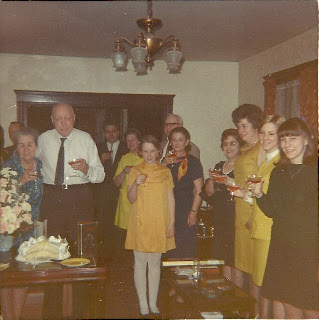
Before they married, Ollave was a teacher in Nashua, New Hampshire, and after their marriage, they lived in Somerville, Belmont, and Cambridge Massachusetts.  Here is a picture of their 50th anniversary party, in 1968.  They are on the far left of this picture.

But while their lives centered on Boston, the plate somehow went on EBay, and ended up at my wedding in Colorado.

I contacted the owner of their family tree on Ancestry, and she sent me the anniversary picture.  Her mother and aunt, Raymond and Ollave's daughters, are still alive and looking forward to having the copper plate back where it belongs.  So it is about to make the journey to Rhode Island, a little closer to where it started.  I hope the Douglass family will enjoy having this little bit of history.